Obtaining a U.S. green card is not simply a change in immigration status — it is a significant turning point that changes the baseline for asset management and taxation. Green card holders generally become U.S. tax residents and must report worldwide income, including income from Korea, along with certain foreign assets, to the United States. For this reason, it's important to plan Korea-U.S. tax matters as a single timeline starting before you obtain your green card, and to prepare for the practical work of filing and remittance together.
Obtaining a U.S. green card is not simply a change in immigration status — it is a significant turning point that changes the baseline for asset management and taxation.
If you plan to buy a home or begin long-term investing in the U.S., transfer assets to your children, or prepare retirement assets, you may be able to use provisions that don't exist in Korea, such as the home-sale gain exclusion, preferential long-term capital gains rates, and the gift and estate tax exemption.
However, green card holders generally become U.S. tax residents and must report worldwide income — including income from Korea — and certain foreign assets to the United States. Korean real estate, corporate equity, and stocks or funds can fall under both countries' systems at once, and moving assets across borders also requires procedures such as foreign exchange transaction reporting and verifying the source of funds. For this reason, it's important to plan Korea-U.S. tax matters as a single timeline starting before you obtain your green card, and to prepare for the practical work of filing and remittance together.
Green card holders are generally classified as U.S. tax residents and must report worldwide income to the United States — not only U.S.-source income but wages, business income, rental income, interest and dividends, and gains from stocks and real estate earned in Korea as well. That said, a broader reporting obligation is not the same thing as a higher tax bill. Tax already paid in Korea can be offset through the foreign tax credit, and the U.S. offers deductions and asset-management tools that don't exist in Korea.
If you plan to actually live in the U.S., build assets there, and eventually pass them on to family, long-term tax planning can let you use provisions such as the following.
Exclusion of gain on the sale of a U.S. primary residence
Preferential long-term capital gains rates
A high gift and estate tax exemption
Relief from double taxation through the foreign tax credit
Long-term asset management using U.S. retirement, education, and investment accounts
For someone who settles in the U.S. long-term and builds assets there, tax options open up that don't exist in Korea. Because the requirements and effective dates differ by provision, which ones you can use — and from when — depends on how your assets are structured and when you convert to resident status.
Tax Advantages Available After Obtaining a U.S. Green Card
The table below summarizes representative provisions you can use if you actually live in the U.S. and meet each provision's requirements.
Item
General Korean Standard
Available After Obtaining a U.S. Green Card
Gifting Assets to a Child
An adult child gets a KRW 50 million exemption per 10 years from a lineal ascendant, then a progressive rate of 10%–50% applies
If subject to U.S. gift tax, assets can be transferred in stages using the per-recipient annual exclusion and the lifetime exemption
Gifting KRW 1 Billion to an Adult Child
With no gifts in the prior 10 years, roughly KRW 225 million in Korean gift tax can result
If requirements are met, no actual U.S. gift tax may be due, within the U.S. lifetime gift and estate tax exemption
Lifetime Gift/Estate Exemption
Exemption amounts by relationship are aggregated in 10-year units
The 2026 U.S. federal gift and estate tax exemption is $15 million per person
Selling Your Primary Residence
Korean capital gains tax exemption is possible if the one-household-one-home requirement is met
If U.S. requirements are met, up to $250,000 of gain (up to $500,000 filing jointly) can be excluded
Selling Long-Held Stock
Korean tax depends on the type of stock and whether you're a majority shareholder, among other factors
U.S. long-term capital gains may be taxed at federal rates of 0%, 15%, or 20% depending on income level
The Same Income Earned in Korea and the U.S.
Reported under each country's own tax rules
Certain income tax paid in Korea can be offset through the U.S. foreign tax credit
Building Assets for a Child
After a gift, typical financial products such as deposits, stocks, and insurance are used
Long-term asset management is possible using U.S. education, investment, and retirement accounts
Retirement Planning
Centered on the National Pension, retirement pension, and personal pension
Long-term planning is possible using various U.S. tax-advantaged retirement accounts
Asset Transfers Between Spouses
KRW 600 million spousal gift exemption per 10 years
If the spouse is a U.S. citizen, an unlimited marital deduction may be available under U.S. federal gift and estate tax rules
In Korea, when an adult child receives a gift from a lineal ascendant, a KRW 50 million exemption applies per 10 years, after which a progressive rate of 10% to 50% applies. Assuming no gifts in the prior 10 years, gifting KRW 1 billion results in a taxable base of KRW 950 million and roughly KRW 225 million in gift tax.
In the U.S., the 2026 gift and estate tax lifetime exemption is $15 million per person, and the annual gift exclusion is $19,000 per recipient. Even if you exceed the annual exclusion, no actual federal gift tax may be due as long as you remain within the lifetime exemption — though a gift tax return may still be required.
The U.S. home-sale gain exclusion requires meeting certain conditions, such as having owned and used the home as your main residence for at least 2 of the 5 years before the sale. The exclusion is generally $250,000, or up to $500,000 if filing jointly as a married couple.
The provisions above do not apply automatically just because you obtain a U.S. green card. The outcome depends on your tax residency status in both the U.S. and Korea, your actual period of residence, citizenship, where your assets are located, and your income level, and Korean tax may also apply. It's important to review your asset structure and the timing of your residency change before you obtain your green card.
Why Tax Planning Before Obtaining a Green Card Matters
Once you become a green card holder, not only assets you newly build in the U.S. but also income and assets you already hold in Korea may become subject to U.S. tax reporting.
Before obtaining a green card, you can choose the timing of a sale or gift; after obtaining it, your options narrow. It's therefore more advantageous to check the following items before obtaining a green card, rather than sorting them out afterward.
1) What to Check Before Obtaining a Green Card
When you convert to tax-resident status under Korean and U.S. law
The acquisition cost and expected capital gain on Korean real estate
Your current holdings of Korean stocks, funds, and ETFs
Your Korean corporate equity holdings and whether you're subject to exit tax on departure
Your Korean bank, brokerage, insurance, and pension account holdings
Securing documentation of acquisition cost for real estate, stocks, and unlisted equity
Gift history among family members over the past 10 years
Future gift plans among parents, children, and spouses
Income tax and estate tax in the state where you plan to settle
Which assets are better sold or gifted before obtaining a green card
Even for the same asset, the tax that applies and the reporting method can differ depending on whether the sale or gift happens before or after you obtain a green card.
Korea/U.S. Tax Residency Determination
Obtaining a U.S. green card is a change in your tax system before it's a change in your life. The starting point for tax isn't the rate — it's which country you're a resident of. Selling the same asset at the same time can produce a different filing country and tax amount depending on your residency determination.
After obtaining a green card and starting life in the U.S., you may consider yourself a U.S. resident, but under Korean tax law you may still be treated as a Korean resident. This happens because the two countries make the determination in different ways.
Category
Korea
United States
Determination Standard
Comprehensive review of housing, family, occupation, assets, and more
Green card holder status, or presence in the U.S. beyond a certain period
Relationship to a Green Card
Obtaining a green card alone does not make you a nonresident
Resident from the moment you obtain a green card
Predictability
Conclusion depends on the specific facts
Standard is clear and predictable
Two misconceptions come up often as a result: "moving to the U.S. means clearing out all Korean assets" and "getting a green card alone automatically ends Korean residency." Residency isn't determined solely by whether assets remain. Korean tax law and the Korea-U.S. tax treaty don't apply individual factors mechanically — they work through a defined sequence of steps and reach a conclusion based on the full set of facts.
If residency status isn't settled by the time you dispose of assets or income arises, it can lead to double taxation or an unexpected tax burden. Converting your residency isn't something to sort out after you leave Korea — it's something to check beforehand, together with your departure timing and your family's relocation schedule.
Asset Transfer and Overseas Remittance
Even after your tax filings are complete, moving funds to the U.S. is a separate process. Sending funds from Korea abroad is subject to reporting under the Foreign Exchange Transactions Act and verification of the source of funds, separately from tax law.
1) The Procedure Depends on the Nature of the Funds
A gift-type remittance from parent to child
An emigrant's transfer of domestic assets abroad
Transfer of proceeds from a real estate sale
Transfer of financial assets such as deposits or stocks
Even for the same amount, the required reporting and supporting documents differ completely depending on which of these applies. Skipping a step means having to go back to an earlier one, so how you first characterize the funds determines the entire timeline.
2) What to Check Before You Proceed
Whether the source of funds can be documented
Whether the supporting records needed at the time of sale or gift still exist
Whether the order of tax filing and remittance reporting is correct
Whether your residency status is settled at the time of remittance
The flow of funds needs to be backed by documentation. Keeping records from the moment you carry out a sale or gift means you won't need to recreate them later.
The source-of-funds documents prepared in this process overlap substantially with the funds-verification materials required in the immigration process. Preparing tax, remittance, and immigration matters on the same timeline means you don't have to build the same documentation twice.
Korean Real Estate
If a green card holder owns or sells real estate in Korea, both Korean and U.S. tax need to be reviewed together.
1) Renting Out Korean Real Estate
If your Korean real estate generates rental income, you must report it in Korea and may also need to report it in the U.S. as part of your worldwide income.
Certain income tax paid in Korea can be offset against U.S. tax through the foreign tax credit. However, not all Korean tax is fully creditable, and additional U.S. tax can result depending on the income category and credit limits.
2) Selling Korean Real Estate and Capital Gains Tax
If a green card holder sells real estate in Korea, they must report capital gains tax in Korea and may also need to calculate and report the gain in U.S. dollars in the U.S.
Scenario
Korea
United States
Selling Korean Real Estate
Capital gains tax applies based on holding period, number of homes owned, residency requirements, and more
Gain is calculated in U.S. dollars based on acquisition and sale price and reported as a capital gain
Korea's One-Household-One-Home Exemption
Exemption available in Korea if requirements are met (if the whole household emigrates, a sale within 2 years of departure can qualify for exemption)
Even if exempt in Korea, separate U.S. tax may still apply
Selling a Korean Rental Property
Both rental income and capital gains tax are reviewed
Depreciation over the rental period and the gain on sale are reviewed together
Coordinating Korean and U.S. Tax
Pay Korean capital gains tax
Review eligible tax for the U.S. foreign tax credit
Even if Korea's one-household-one-home exemption applies, U.S. tax can still result if you separately fail to meet the U.S. home-sale gain exclusion requirements. Conversely, for a home you actually live in within the U.S., meeting the U.S. ownership and use requirements lets you exclude up to $250,000 of gain, or up to $500,000 filing jointly.
U.S. Real Estate
For U.S. real estate, the title and ownership structure you settle on at acquisition carries through to rental income reporting, disposal, and inheritance down the line. Changing the ownership structure later is treated as a transfer or gift under tax law and itself becomes a taxable event, so the decision made at acquisition effectively governs the entire holding period.
1) What to Decide Before Acquisition
Whether to hold title individually, jointly as spouses, or through an entity
Whether to acquire before or after obtaining a green card
Which channel to use to remit the funds
How to account for the tax system of the state where you plan to settle
2) Where Outcomes Diverge Later
Depreciation and expense treatment when reporting rental income
Dollar-based capital gain and long-term preferential rates upon disposal
The scope of taxation at inheritance or gift
If acquired as a Korean resident, submission of Korean holding/disposal statements
When a Korean resident acquires U.S. real estate, obligations arise on both the Korean and U.S. sides, and that structure changes again once a green card is obtained. Property tax, income tax, and estate tax regimes vary significantly by state, so where you plan to settle also needs to be factored in.
Because the range of adjustments narrows after acquisition, reviewing your options before signing a contract is what preserves your choices.
Korean Stocks, Funds & ETFs
Green card holders may need to include dividends and trading gains from Korean stocks, funds, and ETFs in their U.S. income tax return.
Long-term capital gains on stock and similar assets held more than one year in the U.S. can generally be taxed at federal rates of 0%, 15%, or 20% depending on income level, though the net investment income tax (NIIT) and state income tax may add to that.
Funds and ETFs organized in Korea may qualify as a PFIC under U.S. tax law, so it's important to review your holdings before obtaining a green card.
Korean Corporate Equity and Entity Conversion
Equity in a Korean corporation is the asset with the most items to review at the time of obtaining a green card. At the same time, because you can choose when dividends, salary, and equity transfers happen, it's an asset where you can design the sequence to match your immigration timeline.
1) What to Decide Before Obtaining a Green Card
The timing and method of paying dividends, salary, and severance
The equity structure among yourself and family members
How to handle retained earnings accumulated in the corporation
Whether to restructure equity or convert the entity
The sequence between your departure date and your equity clean-up schedule
2) What to Manage After Obtaining a Green Card
U.S. foreign corporation reporting based on ownership percentage
Whether corporate earnings are taxed at the shareholder level
Reporting income received from the Korean corporation in both countries
Aligning filing timing and records between the two countries
A majority shareholder of a Korean corporation needs to review whether to clean up their equity at the time of departure. Because the criteria and requirements are set by law and can be determined in advance, the sequence between your green card timeline and your equity clean-up schedule should be fixed ahead of time.
Dividends, salary, and proceeds from an equity sale are also funds whose source and flow can be documented. These records support the verification materials required at both the tax-filing and fund-transfer stages, so how and when you make these payments should be reviewed together with the steps that follow.
Restructuring equity or converting an entity takes considerable time to execute, and the valuation date determines the outcome. Working backward from your timeline preserves the options available to you.
Gifts & Inheritance
The U.S. differs from Korea in how gift and estate tax is assessed and in the size of the exemptions.
In Korea, the recipient of a gift generally bears the gift tax, but in the U.S., the person making the gift generally bears the filing and payment obligation. Because the taxpayer differs, both countries' systems can apply separately to the same gift.
1) When a Green Card Holder Gifts to a Child
The 2026 U.S. federal annual gift tax exclusion is $19,000 per recipient. Exceeding it may require a Form 709 gift tax return, but no actual federal gift tax may result as long as you remain within the $15 million lifetime gift and estate tax exemption.
However, U.S. gift tax residency isn't determined identically to the income tax green card test — domicile, including intent to reside permanently in the U.S. and your actual center of life, can also be reviewed.
2) When Receiving a Gift From Korean Parents
A properly made gift that a green card holder receives from Korean parents is generally not itself subject to U.S. income tax for the recipient.
However, if the total gifts and bequests received from a foreign individual or foreign estate in a year exceed $100,000, a Form 3520 information return may be required.
Any Korean gift tax must be reviewed separately, so the absence of U.S. gift or income tax should not be read as meaning there is no tax at all.
3) When Inheriting Assets From Korean Parents
In Korea, the heir files and pays estate tax, and property a green card holder inherits from abroad is generally not itself subject to U.S. income tax. However, exceeding $100,000 triggers a Form 3520 information filing requirement, and if inherited Korean real estate or stock is later sold, the gain must be reported in the U.S.
Because the inheritance search and valuation process runs alongside registration and title-transfer procedures in Korea, it helps to manage both countries' practical steps on the same timeline.
Required Tax Filings for Green Card Holders
Green card holders can take advantage of U.S. tax provisions, but must also report worldwide income — including income from Korea — and certain foreign assets to the United States.
Not every green card holder needs to make every filing below; which ones are required depends on income level, financial account balances, assets held, corporate equity, and whether gifts or inheritances are involved.
Filing
Who It Applies To / What to Check
U.S. Individual Income Tax Return
Report worldwide income, including income from both Korea and the U.S.
Foreign Tax Credit (Form 1116)
Whether qualifying income tax paid in Korea can be credited against U.S. tax
FBAR
If the aggregate maximum balance of foreign financial accounts during the year exceeds $10,000
Form 8938
If you hold foreign financial assets above certain thresholds
Form 3520
If you receive gifts or an inheritance from a foreign person above certain amounts
Form 5471
If you own a Korean corporation's equity above a certain percentage
Form 8621
If you hold Korean funds, ETFs, or other financial products that may qualify as a PFIC
State Income Tax Return
Check separate filing requirements depending on your state of residence in the U.S.
Foreign Financial Account Reporting
If a green card holder holds Korean bank accounts, brokerage accounts, funds, or certain insurance accounts, they need to check whether FBAR and Form 8938 apply.
1) FBAR
If the combined maximum balance of your non-U.S. financial accounts exceeds $10,000 at any point during the year, FBAR filing may be required.
Category
Details
Filing Threshold
Aggregate maximum balance of foreign financial accounts exceeds $10,000
How It's Determined
Sum the annual maximum balance of each foreign account
Main Accounts Covered
Bank, deposit, brokerage, and fund accounts, and certain insurance/pension accounts
Whether Income Was Earned
Filing can be required even with no income
Jointly Held Accounts
Reviewed based on the account's full balance, not just your ownership share
Corporate Accounts
Reviewed if you have signature authority, even without ownership
Dormant or Small-Balance Accounts
Included in the total even if the balance is small or the account is unused
2) FATCA / Form 8938
If you hold foreign financial assets above certain thresholds, you may need to attach Form 8938 to your U.S. individual income tax return. FBAR and Form 8938 have different filing agencies, thresholds, and coverage, so filing one does not automatically exempt you from the other.
Foreign real estate held directly by an individual is generally not itself subject to FBAR. However, a Korean financial account that receives rental income, or an ownership structure through a foreign entity, may require separate reporting.
Global Tax Group Daeyang
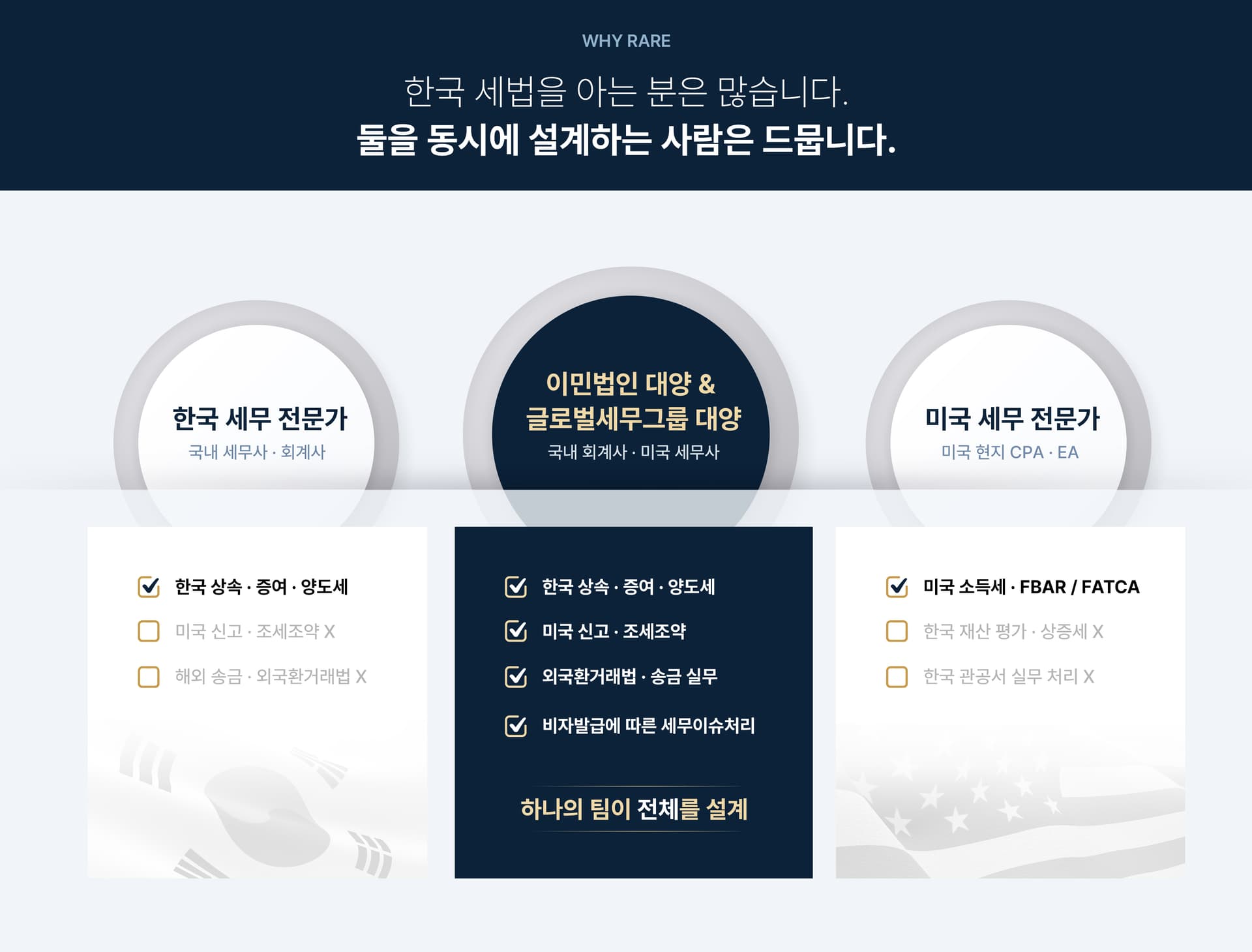
Global Tax Group Daeyang is a specialized tax and accounting group handling the tax matters of individuals and businesses with assets and income spanning Korea and the U.S. When each country's tax work is handled by a separate provider, clients are left to coordinate the overlap between the two systems themselves. At Daeyang, professionals holding both countries' tax credentials and practical experience work as one team across our Korean and U.S. organizations.
Tax outcomes are often determined less by how you file than by how your assets are structured. We design the equity structure of your corporation, how real estate and financial assets are held, and the sequence and timing of transferring assets within the family, all together. The same asset can produce a different tax outcome depending on which country holds it and how, so settling the structure in advance widens your options later.
We run everything on a single timeline — from a tax diagnostic before you obtain a green card, through Korea-U.S. filings afterward, to foreign exchange reporting and source-of-funds verification at the asset-transfer stage, and support if a tax audit follows. We design around your U.S. immigration timeline and your Korean asset structure together, and we don't stop at the design — we see it through to execution.
Former Head of Tax & Accounting, global companies including AIG
M.S., Real Estate, Graduate School of Konkuk University
Korea MBA, Korea University
20+ years of tax experience
Vice Chair, KBS Professors' Association
Key Services
Korea-U.S. tax consulting and diagnostics
International estate and gift planning
Korea-U.S. entity formation and equity structuring (including US-Flip)
Study-abroad and family asset planning for children
Overseas remittance and foreign exchange transaction reporting
Tax audit response and pre-audit diagnostics
Korea-U.S. real estate acquisition and disposal structuring
FAQ
Q.
Will I pay less tax overall if I get a U.S. green card instead of staying in Korea?
If you plan to live in the U.S. long-term, build a home and investment assets there, and transfer assets to your children, you may be able to use the U.S. home-sale gain exclusion, preferential long-term capital gains rates, and the high gift and estate tax exemption. However, Korean tax can continue to apply to your Korean assets and income, so tax planning before obtaining a green card is important.
Q.
If I gift assets to my child after getting a green card, is there no tax at all?
The 2026 U.S. federal gift and estate tax exemption is $15 million per person. If you're subject to U.S. gift tax and gift within your lifetime exemption, no actual federal gift tax may result, but exceeding the annual exclusion may still require a Form 709 filing. Whether Korean gift tax applies must be checked separately.
Q.
Is there a tax benefit when I sell a home I've lived in in the U.S.?
If you meet certain requirements — such as owning and using the home as your main residence for at least 2 of the 5 years before the sale — you can exclude up to $250,000 of gain from income, or up to $500,000 if filing jointly.
Q.
If I sell real estate in Korea, do I also need to report it in the U.S.?
If a green card holder sells real estate in Korea, both Korean capital gains tax and U.S. capital gains reporting need to be reviewed. Qualifying tax paid in Korea can be credited via the foreign tax credit, but differences in exchange rates and acquisition-cost calculations can still result in additional U.S. tax.
Q.
Do I need to report Korean financial accounts and stocks to the U.S. as well?
If the aggregate maximum balance of your foreign financial accounts during the year exceeds $10,000, FBAR may apply. Dividends and trading gains on Korean stocks can also be reportable in the U.S., and Korean funds and ETFs need to be checked separately for PFIC reporting.
Q.
Can I receive a gift from my parents to fund an investment immigration?
Yes. However, the actual remittance can only proceed after completing Korean gift tax filing/payment and source-of-funds verification, and a Form 3520 information return should be reviewed on the U.S. side. Since the source-of-funds documents you prepare are also used in the immigration process, it's best to prepare them to satisfy both sets of requirements from the start.
Request a Consultation
Leave your Korea-U.S. tax questions with us, and a dedicated specialist from Global Tax Group Daeyang will follow up in the order requests are received. Consultations are conducted by phone.